 Add to Chrome
 Add to Firefox
 Add to Edge
CausalGuard: Conformal Inference under Graph Uncertainty
May 21, 2026
Estimating treatment effects from observational data requires choosing an adjustment set, but valid adjustment depends on an unknown causal graph. Graph misspecification can cause under-coverage, while graph-agnostic conformal wrappers may regain nominal coverage only through large padding. We introduce CausalGuard, a structure-weighted conformal framework that calibrates after aggregating graph-conditional doubly robust pseudo-outcomes. Candidate DAGs are proposed from an LLM-derived edge prior, pruned by conditional-independence tests, and reweighted by Bayesian Information Criterion. A composite nonconformity score then calibrates the posterior-weighted pseudo-outcome. CausalGuard provides distribution-free finite-sample marginal coverage for this aggregated pseudo-outcome; under causal identification, overlap, conditional-mean nuisance stability, and concentration on target-aligned valid adjustment strategies, its conditional mean converges to the true Conditional Average Treatment Effect. Across five benchmarks, CausalGuard attains mean coverage above the nominal 90% level for the directly evaluable target and reduces width when graph-agnostic conformal baselines require large padding. Stress tests show that CausalGuard suppresses invalid collider adjustment and remains stable under misspecified priors when the retained candidate set is data-supported.

Overcoming Dynamics-Blindness: Training-Free Pace-and-Path Correction for VLA Models
May 14, 2026Vision-Language-Action (VLA) models achieve remarkable flexibility and generalization beyond classical control paradigms. However, most prevailing VLAs are trained under a single-frame observation paradigm, which leaves them structurally blind to temporal dynamics. Consequently, these models degrade severely in non-stationary scenarios, even when trained or finetuned on dynamic datasets. Existing approaches either require expensive retraining or suffer from latency bottlenecks and poor temporal consistency across action chunks. We propose Pace-and-Path Correction, a training-free, closed-form inference-time operator that wraps any chunked-action VLA. From a single quadratic cost, joint minimization yields a unified solution that decomposes orthogonally into two distinct channels. The pace channel compresses execution along the planned direction, while the path channel applies an orthogonal spatial offset, jointly absorbing the perceived dynamics within the chunk window. We evaluate our approach on a comprehensive diagnostic benchmark MoveBench designed to isolate motion as the sole controlled variable. Empirical results demonstrate that our framework consistently outperforms state-of-the-art training-free wrappers and dynamic-adaptive methods and improves success rates by up to 28.8% and 25.9% in absolute terms over foundational VLA models in dynamic-only and static-dynamic mixed environments, respectively.
Reliability-Gated Source Anchoring for Continual Test-Time Adaptation
May 13, 2026Continual test-time adaptation (CTTA) updates a pretrained model online on an unlabeled, non-stationary stream while anchoring it to a frozen source checkpoint. This anchor is useful only when the source remains reliable. On CCC-Hard, however, a ResNet-50 source falls to approximately $1.3\%$ top-$1$ accuracy, while existing source-anchored CTTA methods continue applying the same anchor strength. We call this failure mode blind anchoring and propose RMemSafe, a reliability-gated extension of ROID that uses the frozen source's normalized predictive entropy to attenuate all explicit source-coupled uses in the objective. When the source posterior approaches uniformity, the gate closes: the source anchor and agreement filter vanish, and the objective reduces to a source-agnostic fallback comprising ROID's base losses plus marginal calibration. Combined with ASR, RMemSafe achieves the lowest error on $8$ of $9$ matched-split continual-corruption cells and is the best reset-based method on all $9$, improving ROID+ASR by $1.05$~pp on ResNet-50 and $0.48$~pp on ViT-B/16. A controlled source-degradation sweep shows a $1.13{\times}$ shallower harm slope than ROID+ASR, consistent with the graceful-decay prediction. The entropy gate detects high-entropy source collapse, not confidently wrong low-entropy sources; this scope is explicitly evaluated and discussed.
Predicting Channel Closures in the Lightning Network with Machine Learning
May 12, 2026The Lightning Network (LN) is a second-layer protocol for Bitcoin designed to enable fast and cost-efficient off-chain transactions. Channels in the LN can be closed either by mutual agreement or unilaterally through a forced closure, which locks the involved capital for an extended period and degrades network reliability. In this paper, we study the problem of predicting channel closure types from publicly available gossip data, framing it as a temporal link classification task over the evolving channel graph. We construct a dataset spanning over two years of LN activity and benchmark a range of machine learning approaches, from MLPs to temporal graph neural networks and spectral encodings. Our experiments reveal that the dominant predictive signals are temporal and behavioural, namely how recently each endpoint was active and the per-node history of past closures, while the surrounding network topology provides no additional benefit. We find that a simple MLP operating on edge-level features, node-level event counts, and temporal patterns outperforms all graph-based approaches, and discuss how the inherent privacy of the LN, where critical information such as channel balances and payment flows remains hidden, fundamentally limits the predictability of closures from gossip data alone. We publicly release the dataset and code at https://github.com/AmbossTech/ln-channel-closure-prediction to encourage further research on this practically relevant task.
Toward Guarantees for Clinical Reasoning in Vision Language Models via Formal Verification
Feb 27, 2026Vision-language models (VLMs) show promise in drafting radiology reports, yet they frequently suffer from logical inconsistencies, generating diagnostic impressions unsupported by their own perceptual findings or missing logically entailed conclusions. Standard lexical metrics heavily penalize clinical paraphrasing and fail to capture these deductive failures in reference-free settings. Toward guarantees for clinical reasoning, we introduce a neurosymbolic verification framework that deterministically audits the internal consistency of VLM-generated reports. Our pipeline autoformalizes free-text radiographic findings into structured propositional evidence, utilizing an SMT solver (Z3) and a clinical knowledge base to verify whether each diagnostic claim is mathematically entailed, hallucinated, or omitted. Evaluating seven VLMs across five chest X-ray benchmarks, our verifier exposes distinct reasoning failure modes, such as conservative observation and stochastic hallucination, that remain invisible to traditional metrics. On labeled datasets, enforcing solver-backed entailment acts as a rigorous post-hoc guarantee, systematically eliminating unsupported hallucinations to significantly increase diagnostic soundness and precision in generative clinical assistants.
Trust The Typical
Feb 04, 2026Current approaches to LLM safety fundamentally rely on a brittle cat-and-mouse game of identifying and blocking known threats via guardrails. We argue for a fresh approach: robust safety comes not from enumerating what is harmful, but from deeply understanding what is safe. We introduce Trust The Typical (T3), a framework that operationalizes this principle by treating safety as an out-of-distribution (OOD) detection problem. T3 learns the distribution of acceptable prompts in a semantic space and flags any significant deviation as a potential threat. Unlike prior methods, it requires no training on harmful examples, yet achieves state-of-the-art performance across 18 benchmarks spanning toxicity, hate speech, jailbreaking, multilingual harms, and over-refusal, reducing false positive rates by up to 40x relative to specialized safety models. A single model trained only on safe English text transfers effectively to diverse domains and over 14 languages without retraining. Finally, we demonstrate production readiness by integrating a GPU-optimized version into vLLM, enabling continuous guardrailing during token generation with less than 6% overhead even under dense evaluation intervals on large-scale workloads.
HugRAG: Hierarchical Causal Knowledge Graph Design for RAG
Feb 04, 2026Retrieval augmented generation (RAG) has enhanced large language models by enabling access to external knowledge, with graph-based RAG emerging as a powerful paradigm for structured retrieval and reasoning. However, existing graph-based methods often over-rely on surface-level node matching and lack explicit causal modeling, leading to unfaithful or spurious answers. Prior attempts to incorporate causality are typically limited to local or single-document contexts and also suffer from information isolation that arises from modular graph structures, which hinders scalability and cross-module causal reasoning. To address these challenges, we propose HugRAG, a framework that rethinks knowledge organization for graph-based RAG through causal gating across hierarchical modules. HugRAG explicitly models causal relationships to suppress spurious correlations while enabling scalable reasoning over large-scale knowledge graphs. Extensive experiments demonstrate that HugRAG consistently outperforms competitive graph-based RAG baselines across multiple datasets and evaluation metrics. Our work establishes a principled foundation for structured, scalable, and causally grounded RAG systems.
VERGE: Formal Refinement and Guidance Engine for Verifiable LLM Reasoning
Jan 27, 2026Despite the syntactic fluency of Large Language Models (LLMs), ensuring their logical correctness in high-stakes domains remains a fundamental challenge. We present a neurosymbolic framework that combines LLMs with SMT solvers to produce verification-guided answers through iterative refinement. Our approach decomposes LLM outputs into atomic claims, autoformalizes them into first-order logic, and verifies their logical consistency using automated theorem proving. We introduce three key innovations: (1) multi-model consensus via formal semantic equivalence checking to ensure logic-level alignment between candidates, eliminating the syntactic bias of surface-form metrics, (2) semantic routing that directs different claim types to appropriate verification strategies: symbolic solvers for logical claims and LLM ensembles for commonsense reasoning, and (3) precise logical error localization via Minimal Correction Subsets (MCS), which pinpoint the exact subset of claims to revise, transforming binary failure signals into actionable feedback. Our framework classifies claims by their logical status and aggregates multiple verification signals into a unified score with variance-based penalty. The system iteratively refines answers using structured feedback until acceptance criteria are met or convergence is achieved. This hybrid approach delivers formal guarantees where possible and consensus verification elsewhere, advancing trustworthy AI. With the GPT-OSS-120B model, VERGE demonstrates an average performance uplift of 18.7% at convergence across a set of reasoning benchmarks compared to single-pass approaches.
Mid-Think: Training-Free Intermediate-Budget Reasoning via Token-Level Triggers
Jan 11, 2026Hybrid reasoning language models are commonly controlled through high-level Think/No-think instructions to regulate reasoning behavior, yet we found that such mode switching is largely driven by a small set of trigger tokens rather than the instructions themselves. Through attention analysis and controlled prompting experiments, we show that a leading ``Okay'' token induces reasoning behavior, while the newline pattern following ``</think>'' suppresses it. Based on this observation, we propose Mid-Think, a simple training-free prompting format that combines these triggers to achieve intermediate-budget reasoning, consistently outperforming fixed-token and prompt-based baselines in terms of the accuracy-length trade-off. Furthermore, applying Mid-Think to RL training after SFT reduces training time by approximately 15% while improving final performance of Qwen3-8B on AIME from 69.8% to 72.4% and on GPQA from 58.5% to 61.1%, demonstrating its effectiveness for both inference-time control and RL-based reasoning training.
$K^4$: Online Log Anomaly Detection Via Unsupervised Typicality Learning
Jul 26, 2025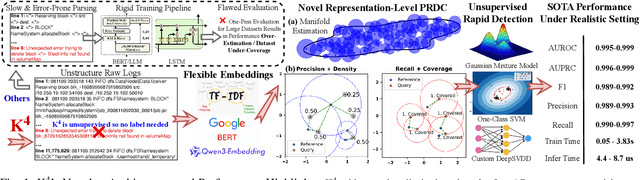
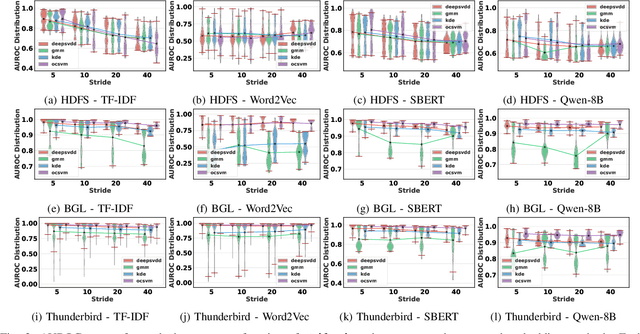
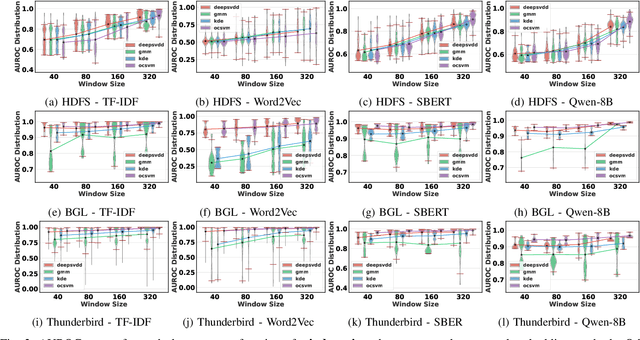
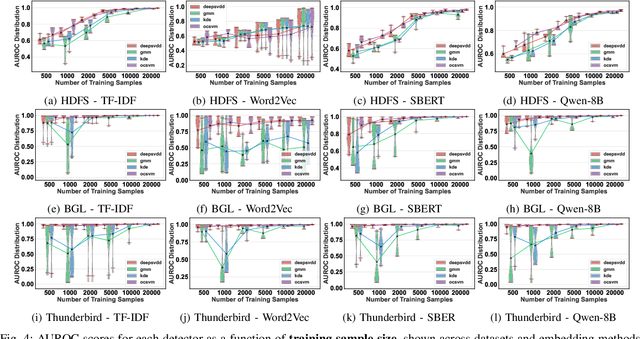
Existing Log Anomaly Detection (LogAD) methods are often slow, dependent on error-prone parsing, and use unrealistic evaluation protocols. We introduce $K^4$, an unsupervised and parser-independent framework for high-performance online detection. $K^4$ transforms arbitrary log embeddings into compact four-dimensional descriptors (Precision, Recall, Density, Coverage) using efficient k-nearest neighbor (k-NN) statistics. These descriptors enable lightweight detectors to accurately score anomalies without retraining. Using a more realistic online evaluation protocol, $K^4$ sets a new state-of-the-art (AUROC: 0.995-0.999), outperforming baselines by large margins while being orders of magnitude faster, with training under 4 seconds and inference as low as 4 $\mu$s.